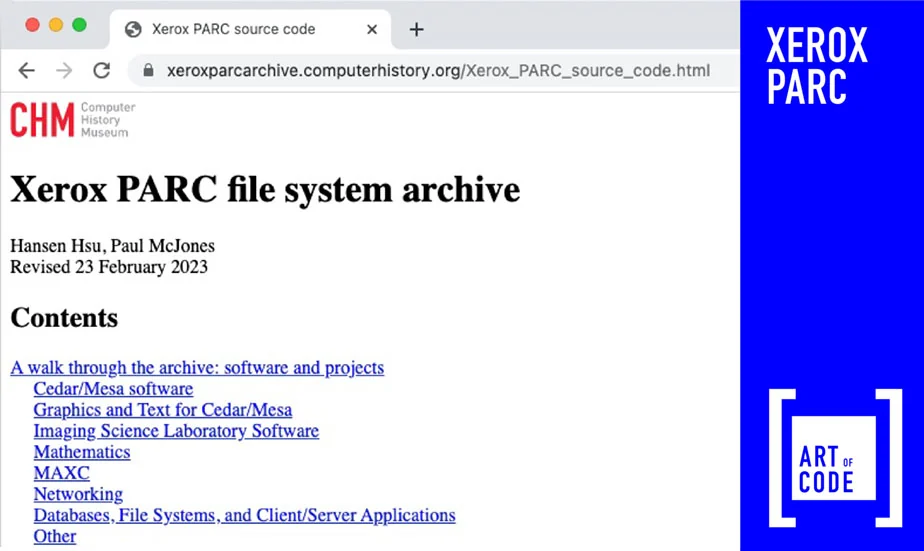
The record
Xerox founded the Palo Alto Research Center in 1970 as a corporate research lab aiming, according to a Computer History Museum account published in 2023, to build the technical basis for “the office of the future.” Two researchers PARC hired toward that goal, Chuck Geschke and John Warnock, left in 1982 to found Adobe Systems. The same account states their departure followed frustration with “the slow pace” of Xerox's own commercialization of a PARC printing-language project called Interpress, which the pair had worked on with colleagues before leaving to build a similar idea, later PostScript, independently.
What the documents establish
PARC's own institutional history, now published by SRI International following PARC's 2023 integration into that organization, confirms the 1970 founding date and credits the lab with Ethernet, laser printing and the Alto personal computer, but this retrospective page does not itself narrate any specific licensing or spinout arrangement. The museum's account supplies the one commercialization sequence documented in detail here: two named researchers, a named prior project inside Xerox, and a stated reason for leaving. That is a documented departure-and-founding story, not a documented dollar figure for value that left with them; neither source cited here quantifies a loss to Xerox.
The operating read
The popular version of this story treats Xerox as having missed PARC's inventions wholesale. What the record actually supports is narrower: a specific pair of researchers judged their employer's pace of commercializing one specific project too slow and left to build their own version of it, later profitably, as Adobe. That is a statement about internal speed of execution on one project, not a verified account of every PARC technology's fate. A research lead evaluating an organization's own technology-transfer practice should ask about commercialization speed project by project rather than assume a single dramatic “missed opportunity” applies uniformly. This is an editorial generalization from one documented case, not a claim either source makes itself.
What to check before you decide
Before citing Xerox PARC as evidence about corporate research generally, check the following.
- Is the specific technology and departure being cited the Adobe and Interpress case, or a different PARC story that may lack similar documentation?
- Does the source quantify value Xerox retained or lost, or only describe the sequence of events?
- Is “PARC” being used to mean the original Xerox-owned lab, the later independent PARC Inc., or its current form inside SRI International?
The Adobe departure is a documented instance of slow internal commercialization prompting a spinout. It is evidence about one project's pace, not a verified balance sheet of what Xerox gained or lost from PARC as a whole.
Sources & their limits
These are the existing record’s sources and retrieval dates, preserved from the archive. Source statements, historical events and editorial interpretation are distinct.
- A Backup of Historical Proportions
Computer History Museum account of PARC's 1970 founding and of Geschke and Warnock leaving to found Adobe over the pace of Interpress commercialization.
- Future Concepts Division (PARC) — SRI International
PARC's own successor institution confirming the 1970 founding, the 2002 independence and the 2023 integration into SRI, and crediting Ethernet, laser printing and the Alto.