The record
The TSX Venture Exchange's Capital Pool Company program, set out in Policy 2.4 of TMX's Corporate Finance Manual, lets a newly formed company with no assets other than cash and no commercial operations complete an IPO and list on the exchange before it has identified any business to acquire. The policy states the only permitted activity for a CPC is identifying and evaluating assets or businesses with a view to completing a Qualifying Transaction. A CPC's IPO must raise gross proceeds of at least CAD 200,000 and no more than CAD 9,500,000 to the company treasury, with the combined total from seed shares, the IPO and any private placement capped at CAD 10,000,000, and directors and senior officers must together subscribe for seed shares worth at least the greater of CAD 100,000 or 5% of all pre-listing proceeds. Once listed, the CPC then has a window of 24 months from the date of listing to complete a Qualifying Transaction, an acquisition that converts the shell into an operating Tier 1 or Tier 2 issuer.
What the documents establish
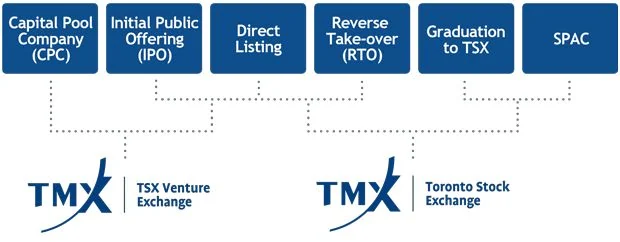
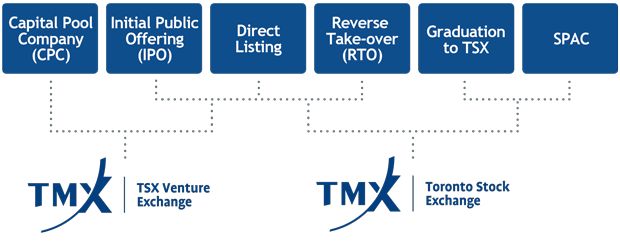
Policy 2.4's own text, current as at March 31, 2026, is the source for every figure above; this is TMX's rulebook, not a promoter's description of the program. TMX's own current listings page separately lists the Capital Pool Company Program as one of several distinct routes onto the exchange, alongside a conventional IPO, a direct listing, a reverse take-over and a Special Purpose Acquisition Corporation, confirming TMX itself treats the CPC as a named, ongoing structure rather than a historical artifact. Reading the two together shows the program's logic: capital is raised and admitted to trading first, on a small, capped scale, and the operating business is found afterward, subject to shareholder and Exchange approval of the eventual transaction.
The operating read
A CPC differs from a US-style blank-check special purpose acquisition company in ways the policy makes specific: the proceeds cap is far smaller, a CAD 9,500,000 ceiling versus the larger sums a SPAC typically raises, the vehicle lists on a junior Canadian exchange rather than Nasdaq or the NYSE, and Policy 2.4 sets director seed-capital and escrow requirements with no direct SPAC equivalent. Describing a CPC as a Canadian SPAC without naming these differences risks importing US expectations, deal size, sponsor economics, redemption rights, that Policy 2.4 does not provide for.
What to check before you decide
Before comparing a CPC to any other shell-company structure, check the following against Policy 2.4 and the CPC's own prospectus.
- How much of the 24-month Qualifying Transaction window has elapsed, and what happens under the policy if the deadline is missed?
- Did the CPC raise proceeds within the CAD 200,000 to CAD 9,500,000 band, and does the aggregate stay under the CAD 10,000,000 cap?
- What seed-share and escrow commitments do the CPC's directors and officers carry, and how do they align with public shareholders?
Policy 2.4, as retrieved on 16 September 2026, remains the governing document for this specific Canadian mechanism, and its terms should not be read as a translation of any other jurisdiction's shell-company rules.
Sources & their limits
These are the existing record’s sources and retrieval dates, preserved from the archive. Source statements, historical events and editorial interpretation are distinct.
- TSX Venture Exchange Corporate Finance Manual, Policy 2.4: Capital Pool Companies
Sets the CPC structure, the CAD 200,000-9,500,000 IPO proceeds range, the CAD 10,000,000 aggregate cap, and the 24-month Qualifying Transaction deadline.
- Listing With Us
TMX's own current page listing the Capital Pool Company Program as one of the routes to list on TSX Venture.