The record
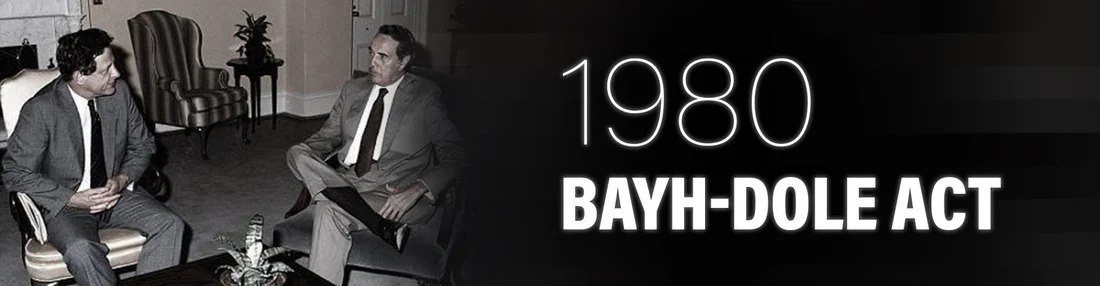
On 12 December 1980 the president signed Public Law 96-517, the University and Small Business Patent Procedures Act, commonly called the Bayh-Dole Act. The enacted text added a new chapter 18 to Title 35 of the United States Code, opening with a policy section listing Congress's purposes: promoting utilization of federally supported inventions, encouraging small-business participation in federal research, promoting collaboration between businesses and nonprofits including universities, and ensuring the government retains rights sufficient to meet public needs. Section 202 of that same enacted text let a nonprofit organization or small-business contractor elect, within a set time after disclosing an invention, to retain title to inventions made under a federal funding agreement, subject to exceptions for government-operated facilities, exceptional agency circumstances, and national-security determinations. A contractor that elected title had to file a patent application before a one-year statutory bar date.
What the documents establish
The enacted statute, not a later description of it, is the source for what changed: title could pass to the performing organization rather than defaulting to the funding agency, conditioned on disclosure, an election window, and a filing deadline. The current codification at 35 U.S.C. 200 preserves this policy language, and its own historical note confirms the December 1980 enactment along with a later 2000 amendment, Public Law 106-404, adjusting wording about avoiding a hindrance to future research. Separately, the National Institute of Standards and Technology's current administration page, as retrieved on 16 September 2026, is a living document describing the agency's coordination role for what it calls Bayh-Dole contractors and recent rulemaking on march-in rights; it does not restate what the 1980 text changed, so this entry relies on it only for present-day administration, not the statute's original terms.
The operating read
This is an editorial reading beyond the statute itself. A founder whose company licenses a patent that originated in university or federal-laboratory research should expect the license to reference an election of title made by the performing institution, not an automatic grant to it. The statute does not by itself establish that any particular university spinout's technology was in fact developed with federal funding, nor that a university actually made a timely election; those are facts specific to a given invention's funding agreement and disclosure history, verifiable only in the underlying records the licensor holds. A memo that cites Bayh-Dole rights without naming the funding agreement, agency, and disclosure date is describing the framework, not the specific chain of title.
What to check before you decide
Before relying on a university or federal-lab license that invokes this framework, check the paperwork rather than the shorthand.
- Does the license identify the specific federal funding agreement and agency that supported the invention?
- Did the disclosure and election of title fall within the statutory windows, and was a patent application filed before the one-year bar date?
- Does the license disclose whether the government retains march-in rights or a nonexclusive license under agency regulations?
This is an editorial checklist, not legal advice; counsel should confirm chain of title against the actual funding agreement rather than a general description of the Act.
Sources & their limits
These are the existing record’s sources and retrieval dates, preserved from the archive. Source statements, historical events and editorial interpretation are distinct.
- Public Law 96-517, University and Small Business Patent Procedures Act of 1980
Enacted text of the policy and objective section and the small-business and nonprofit title-election provision, approved 12 December 1980.
- 35 U.S.C. 200 - Policy and objective (current codification)
Current codified policy text with a historical note dating the underlying enactment to Public Law 96-517 and a later 2000 amendment.
- Bayh-Dole Act (NIST Technology Partnerships Office)
NIST's current administration page for Bayh-Dole contractors, including march-in rights procedures, as the document stood on 16 September 2026.