The record
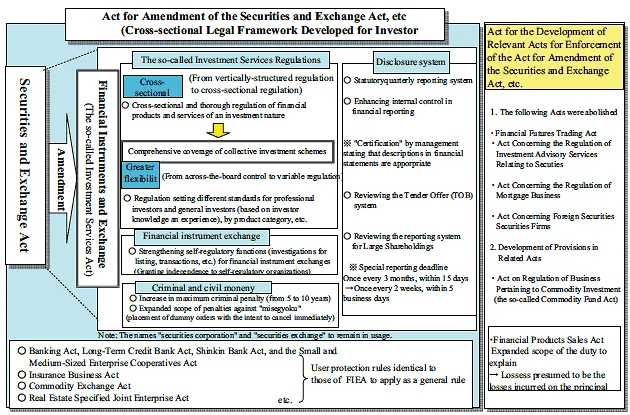
Japan's Financial Instruments and Exchange Act (FIEA) requires companies to make statutory disclosure through EDINET, the Financial Services Agency's electronic disclosure system, described by the agency as comparable in function to the SEC's EDGAR. The FSA's own English-language page on the Act states it took effect on 30 September 2007, following its 2006 enactment, and that the Act's Quarterly Reporting System, Internal Control Reporting System and management certification system were enforced from that date and became applicable from the business year beginning on or after April 1, 2008. Those three systems are what require a listed company to file quarterly reports, an internal-control report and a signed management certification alongside its annual securities report, all through EDINET.
What the documents establish
The FSA's own page, not a law firm's client alert, is the source for the 2007 effective date and the 2008 applicability of the quarterly and internal-control regimes; it also frames the 2006-2007 amendment as one of four pillars, alongside investor-protection rules for financial products, disclosure enhancement and self-regulatory oversight of exchanges. Separately, EDINET's own public portal carries a notice, in Japanese, warning that the Financial Services Agency and local finance bureaus do not certify that information disclosed through EDINET is accurate, that it omits nothing material to an investment decision, or that it guarantees the value of the disclosed securities, a warning issued specifically against solicitations that misuse an EDINET filing as a claim of safety. That notice performs the same function as the disclaimer language on other national filing systems: a filing being accepted for statutory disclosure is not the regulator's endorsement of it.
The operating read
A reader comparing EDINET filings to a US 10-K should not assume the same audit or internal-control standard applies without separately checking which accounting framework, Japanese GAAP, US GAAP or IFRS, and which audit regime under Japan's own accounting rules governs the specific filer. EDINET is a filing and disclosure conduit; the Tokyo Stock Exchange separately runs its own timely-disclosure network, TDnet, for exchange-specific announcements, so a complete picture of a Japanese listed company's disclosure record editorially requires checking both systems, not one.
What to check before you decide
Before treating an EDINET filing as equivalent to a US or UK statutory filing, check the following.
- Which accounting and audit framework does the specific securities report state it was prepared and audited under?
- Does the filing sit inside the Quarterly Reporting and Internal Control Reporting systems that apply from fiscal years starting on or after 1 April 2008, or does it predate that regime?
- Has the equivalent exchange timely-disclosure record, via TDnet, been checked separately from the EDINET statutory filing?
The FIEA's disclosure architecture, as retrieved on 16 September 2026, remains a two-track system, statutory filings through EDINET and exchange disclosure through TDnet, and neither track is a certification of accuracy by the regulator that hosts it.
Sources & their limits
These are the existing record’s sources and retrieval dates, preserved from the archive. Source statements, historical events and editorial interpretation are distinct.
- Financial Instruments and Exchange Act
FSA's own English page stating the FIEA's 2007 effective date and the 2008 applicability of the Quarterly Reporting and Internal Control Reporting systems.
- EDINET
EDINET's own portal notice stating the Financial Services Agency does not certify the accuracy or investment value of information disclosed through the system.