The record
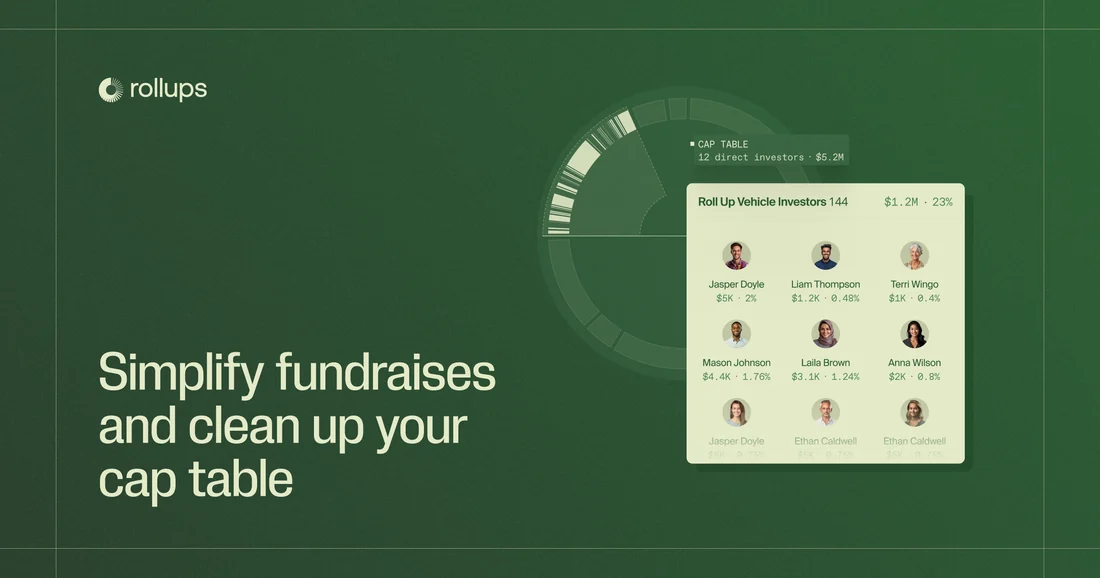
AngelList operates Roll Up Vehicles through a dedicated product site, Rollups.com, linked from AngelList's own homepage under fund administration alongside Rolling Funds and SPVs, as retrieved on 16 September 2026. The product's own RUV page describes the core mechanic: it lets a company 'raise capital from many investors in a single entity,' resulting in 'one line on your cap table' instead of tracking each investor individually. That same page states a company's founder 'manages the RUV' but 'is not required to play a formal material role,' and that the vehicle handles 'KYC/AML, accreditation, and banking, all powered by AngelList.' Eligibility is limited to 'private companies that have raised (or are raising) venture capital' where 'all investors must be accredited.'
What the documents establish
The Rollups.com page states the fee structure directly: an '$8,000 flat rate for US C-Corporations' as the base setup cost, plus state filing fees that 'typically range between $750–$1,250, depending on investor locations,' with 'no upfront fees, no hidden costs' since the company pays 'when you close the RUV.' The page distinguishes an RUV from a traditional special purpose vehicle by removing an external manager: it describes a conventional SPV as involving 'external investors, who are actively involved in the management of the SPV and typically receive performance-based compensation,' while an RUV keeps the founder in control instead. It also lays out a timeline of roughly thirty days from opening invitations to a single closing wire. The AngelList homepage does not restate these figures; it establishes only that RUVs sit within AngelList's broader suite of fund-administration products, distinct from syndicates and Rolling Funds.
The operating read
Editorially, the documentation's framing cuts against a common shorthand that treats a roll-up vehicle like a syndicate led by an outside investor: as AngelList describes it, the company itself opens and nominally manages the RUV to simplify its own cap table, not a lead investor pooling other people's checks the way a syndicate does. A founder consolidating a long list of small checks into one round should weigh the flat setup cost and state filing fees against the administrative time saved from not managing dozens of individual signatures and wires directly.
What to check before you decide
Before opening a Roll Up Vehicle for an upcoming round, check the following against the current product terms.
- Do all participating investors meet the accreditation requirement the documentation states as a condition of using an RUV?
- Does the $8,000 base fee plus the stated $750–$1,250 state filing range match the quote given for this specific closing?
- Is the underlying financing itself venture-capital eligible under the terms Rollups.com states, and does the company's own counsel agree the structure fits the round being raised?
This is a description of AngelList's own published product terms as retrieved on 16 September 2026, not a claim about deal volume or adoption, which AngelList's own materials do not state here.
Sources & their limits
These are the existing record’s sources and retrieval dates, preserved from the archive. Source statements, historical events and editorial interpretation are distinct.
- Roll Up Vehicles (RUV)
States who opens an RUV, the $8,000 setup fee and state filing fee range, the closing timeline, and eligibility requirements.
- Rollups
Describes the core mechanic of consolidating investors into one cap-table line and the services AngelList provides.
- AngelList
Places Roll Up Vehicles within AngelList's broader fund-administration product suite, distinct from syndicates and Rolling Funds.